
SEO in Nepal 2026: Proven Guide to Rankings, Revenue & Careers
Over 16.5 million Nepalis are online. 95% of them use a mobile phone to browse. And most of your competitors are still paying someone to stuff keywords and buy backlinks.
That is the real state of SEO in Nepal today. The market is full of digital opportunity. But too many agencies sell outdated tactics at high prices. SkipTheLogic was built to fix that. We skip the fluff and deliver organic growth built on data.
This guide covers everything. Business owners, career seekers, and marketing managers will all find what they need here. By the end, you will know exactly what to do, what to spend, and what results to expect.
The 2026 Landscape of SEO in Nepal — What the Numbers Say ?
Internet Use & User Behavior in 2026
Nepal has over 16.5 million internet users. That is about 52% of the population. The number keeps growing as 4G spreads and fiber reaches more cities.
Growth is not slowing down. The Nepal Telecommunications Authority reports steady year-over-year gains in mobile data subscriptions. Every new user is a potential customer for a business that shows up on Google.
Google controls 96%+ of Nepal's search market. Bing and Yahoo are not real competitors here. SEO in Nepal means Google SEO — full stop.
Here is the most important number: 95% of searches in Nepal come from mobile devices. This is not a future trend. It is already here. Ncell and NTC carry most of that traffic. The average user browses on a mid-range Android phone on a 4G connection.
Your website's first impression is almost always on a small screen. Speed and mobile design are not optional extras. They are the baseline.
How Search Behavior Has Changed
"Near me" searches have jumped 60%+ year over year in the Kathmandu Valley. Queries like "accountant Baneshwor" or "restaurant open now Thamel" show strong buying intent. Businesses with local SEO win these clicks. Those without miss them.
People also search differently now. They type shorter queries on mobile. They ask questions as if talking to a person. "Best SEO agency Kathmandu" is giving way to "which SEO agency in Kathmandu is good for small business." This shift matters for how you write content.
Zero-click searches are also rising fast. Google's AI Overviews now answer many queries right on the results page. Users get answers without clicking any website. If your content is structured well, Google features you at the top. If not, a competitor gets that spot instead.
Voice search in Nepal is still growing. Queries like "नजिकै राम्रो रेस्टुरेन्ट" (good restaurant nearby) are picking up in cities. This trend will get bigger each year. Businesses that prepare for it now will have a head start.
YouTube search is also worth noting. Many Nepali users search for tutorials, reviews, and how-to content on YouTube before making decisions. An SEO strategy that ignores video is missing a big piece of the Nepali digital picture.
Google's Core Updates & Their Impact on Nepali Sites
Google's Helpful Content System rewards content written for real people. It penalizes content made just to game rankings. Many thin Nepali affiliate blogs have already lost traffic because of this.
The pattern is clear. Sites with short, low-effort articles dropped. Sites with detailed, original content went up. This is not a temporary shift. It is how Google will work going forward.
E-E-A-T is Google's quality framework. It stands for Experience, Expertise, Authoritativeness, and Trustworthiness. Here is what each means for Nepali sites:
- Experience: Has the author actually done what they write about? Lived experience carries weight.
- Expertise: Are credentials visible on the page? Make your author's background clear.
- Authoritativeness: Do other sites link to and mention you? Build a real web presence.
- Trustworthiness: Does your site have HTTPS, a privacy policy, author bios, and real contact details?
Sites using Private Blog Networks (PBNs) for links face growing penalties. Google's 2025 spam updates hit this practice hard. The risk is not worth it.
What works instead? Earning links through great content and real relationships. It takes longer. But the results last.
Generative Engine Optimization (GEO) — The New SEO Frontier
What Is GEO?
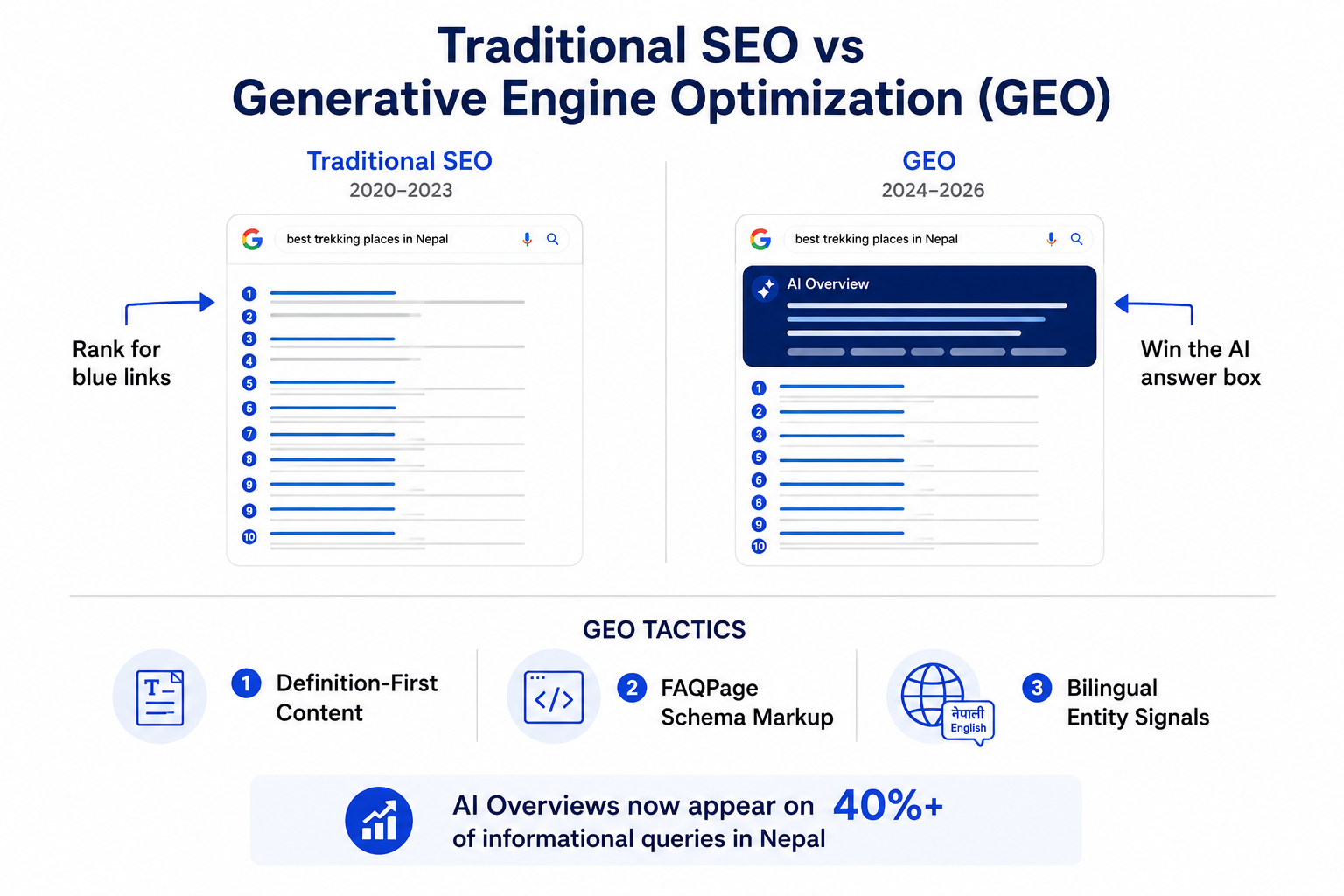
Generative Engine Optimization (GEO) means writing and structuring content so AI search systems can find, quote, and feature it. This includes Google's AI Overviews, Perplexity, and ChatGPT Search. Unlike traditional SEO, GEO targets the AI-generated answer at the top of the page — not just the blue links below it.
AI Overviews now appear on a large share of searches in Nepal. If your content is not structured for AI readability, you are invisible in that part of the page.
This is brand new territory for Nepal. Very few local sites have adapted. That is a huge opportunity for businesses that move now.
Definition-First Content Architecture
Definition-First Architecture means opening every section with a short, direct answer. Give the answer in 2–3 sentences. Then expand with data, context, and depth.
AI Overviews pull from clear, direct answers. Structure each section like a mini featured snippet. Lead with the answer. Then back it up.
Few Nepali sites do this today. That is your advantage. Adopt this structure now and you capture visibility before competitors catch on.
Think of it this way. When someone searches "what is local SEO Nepal," Google wants to show the clearest, most direct answer. If your page opens with a clean definition, you are far more likely to get picked. If your page buries the answer in paragraph three, you get skipped.
How to Optimize for AI Overviews
Schema markup connects your content to AI systems. The most useful schema types for Nepali sites are:
- FAQPage schema: Puts your Q&A directly in line for AI Overview selection.
- LocalBusiness schema: Signals your location for maps and local AI results.
- Article schema: Shows author and publisher details to support E-E-A-T.
- HowTo schema: Captures step-by-step queries like "how to set up a Google Business Profile."
Bilingual signals matter too. A page that targets English keywords and supports them with Nepali content (Devanagari or romanized) tells Google this content is for Nepal. AI systems use that signal when picking what to show for Nepali queries.
Keep your sentences short in every section. AI systems pull clean, simple text. Long, complex sentences get ignored or cut. Write the way you would explain something to a friend.
Local SEO in Nepal — Winning Kathmandu and Beyond
What Is Local SEO?
Local SEO means making your business show up when nearby people search for what you sell. For Nepali businesses, this means ranking in Google's Local Pack (the map with 3 listings), Google Maps, and local organic results.
"Near me" searches are up 60%+ in the Kathmandu Valley. For most Nepali SMEs, local SEO gives the best return on investment. It beats broad national campaigns for businesses with local customers.
Optimizing Your Google Business Profile
Your Google Business Profile (GBP) is your most powerful local SEO tool. A full, optimized GBP helps you appear in the 3-Pack — the top three local listings that get most of the clicks.
Many Nepali businesses have a GBP but leave it half-empty. That is the same as leaving money on the table. A fully filled profile outranks an empty one every time.
GBP optimization checklist for Nepal:
- Primary category: Pick the most exact match. "Digital Marketing Agency" beats "Marketing Agency."
- NAP consistency: Your Name, Address, and Phone must match on your GBP, website, and every directory. Even small formatting differences hurt rankings.
- Business description: Use up to 750 characters. Lead with your main keyword and service area. Name the neighborhoods you serve.
- Photos: Add at least 10 high-quality photos. Exterior, interior, team, and work samples all help. More photos mean more clicks.
- Services: Fill in every service with a short description. Google indexes these.
- Google Posts: Publish at least 2 posts per month. Offers and updates improve engagement.
- Q&A: Add the questions your customers ask most. Answer them clearly.
- Reviews: A steady stream of real reviews beats a one-time burst. Build a simple follow-up process — a WhatsApp message or a QR code at checkout works well.
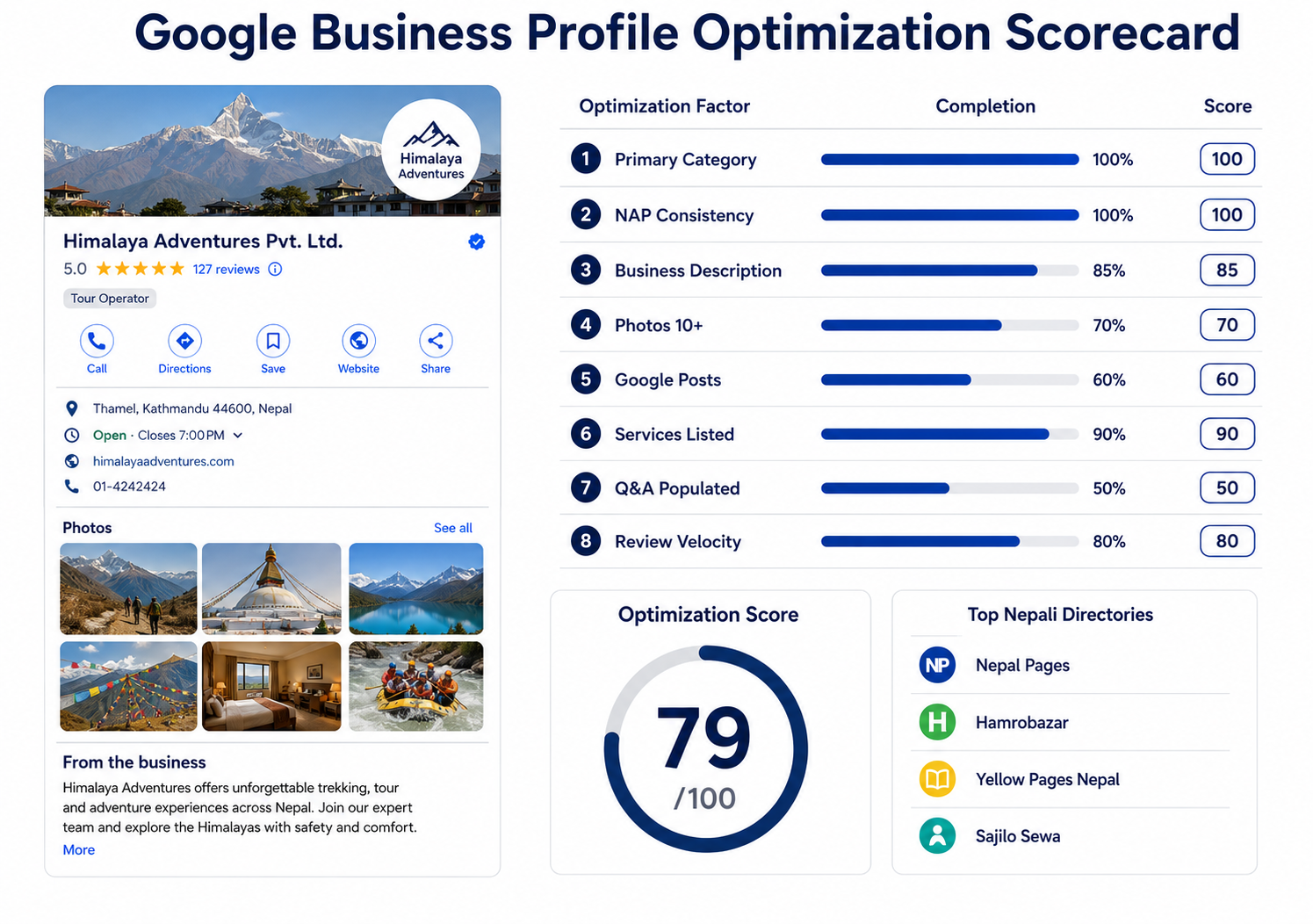
Top Nepali directories for local citations:
Nepal Pages, Hamrobazar, Yellow Pages Nepal, Sajilo Sewa, Nepal Business Directory, and your local Chamber of Commerce listing (FNCCI or CNI).
Make sure your business name, address, and phone number are exactly the same on every listing. Even a small difference — "Rd" vs "Road" — can confuse Google and lower your local rankings.
Hyperlocal Keywords for Nepal
Neighborhood-level keywords are under-used and under-competed in Nepal. "Digital marketing agency Lazimpat" or "SEO company Baneshwor" gets fewer searches than "SEO Nepal." But the people searching are closer to buying.
This is the core idea of hyperlocal SEO. Fewer searchers, but every searcher has high intent. A plumber in Patan who ranks for "plumber Patan" will get more calls than one who chases "plumber Nepal" and ranks nowhere.
Build keyword clusters around:
- Area names: Thamel, Lazimpat, Koteshwor, New Baneshwor, Patan, Pokhara Lakeside, Biratnagar
- Service + area pairs: "accountant Chabahil," "web design company Pulchowk"
- Language variants: English, romanized Nepali, and Devanagari where useful
Create a separate page for each major area you serve. Each page targets that area's keywords. This gives Google a clear signal about where you operate and who you serve.
Review Management for Nepali Businesses
Reviews are the #1 trust signal for Nepali service businesses. Most people read reviews before calling a business. A profile with 50 reviews beats one with 5 — even if the 5 are all five stars.
The best way to get reviews is to ask. Do it right after a good experience. A simple WhatsApp message works well in Nepal. "Thank you for visiting us! If you have a moment, a Google review would mean a lot to us." Include a direct link to your review page.
Never buy fake reviews. Google detects them. Fake reviews can get your profile suspended. Real reviews from real customers are the only safe path.
When you get a negative review, respond calmly. Thank the person for their feedback. Offer to fix the issue. A good response to a bad review shows future customers that you care. It can actually build trust.
Technical SEO on Nepal's Network Reality
Why Core Web Vitals Matter
Core Web Vitals are Google's speed and experience metrics. They measure three things: how fast the main content loads (LCP), how stable the page is while loading (CLS), and how fast the page responds to taps and clicks (INP). Google uses these as a ranking signal.
On Nepal's mobile network, a slow site pays twice. You rank lower. And users leave faster.
Think about the average Nepali user. They are on a mid-range phone. They may be on a 3G connection in some areas. If your site takes 6 seconds to load, they will leave before they even see your content. You lose the ranking and the customer at the same time.
Page Speed Benchmarks for Nepal
| Metric | Good | Needs Work | Poor |
|---|---|---|---|
| LCP | Under 2.5s | 2.5s – 4.0s | Over 4.0s |
| CLS | Under 0.1 | 0.1 – 0.25 | Over 0.25 |
| INP | Under 200ms | 200ms – 500ms | Over 500ms |
Ncell 4G in urban areas runs about 8–15 Mbps. NTC fiber runs 50–100 Mbps in broadband zones. Your site must load well across both. Test with Google PageSpeed Insights and WebPageTest. Use a Kathmandu server location for accurate results.
Run your test on a real mobile device too. What looks fast on a laptop in a fiber office can feel slow on a phone in Boudha.
Technical SEO Checklist for Nepali Sites
Crawlability and indexing:
- Submit an XML sitemap to Google Search Console
- Check robots.txt — make sure CSS and JS are not blocked
- Every key page should be reachable within 3 clicks from the homepage
- Fix orphan pages (pages with no internal links pointing to them)
- Use 301 redirects only; avoid redirect chains longer than 2 hops
On-page technical fixes:
- Enforce HTTPS sitewide and fix any mixed content errors
- Add canonical tags to paginated and duplicate pages
- Implement and test Schema markup using Google's Rich Results Test
- Convert images to WebP format; add width, height, and alt text to all images
- Use lazy loading for images below the fold
Mobile must-haves:
- Use responsive design; test on Samsung Galaxy A-series (the most common device in Nepal)
- Keep tap targets at least 48×48 pixels
- Remove full-screen pop-ups that appear on page load — Google penalizes these
- Set body text to at least 16px for easy mobile reading
WordPress SEO for Nepal
Most Nepali websites run on WordPress. This is good news. WordPress has strong SEO tools built in.
Install either Yoast SEO or RankMath. Both are free and excellent. They handle XML sitemaps, meta tags, and schema markup with little effort. They also give you a readability score for each post — aim for green on every article.
Use a fast, lightweight theme. Heavy page builders like Divi or Elementor can slow your site. Test your theme's speed before you commit to it. Themes like GeneratePress or Kadence are known to be fast.
Use a caching plugin. WP Rocket is the best option but it costs money. W3 Total Cache and LiteSpeed Cache are free and work well. Caching alone can cut your load time in half.
Use a CDN (Content Delivery Network). Cloudflare's free plan works well for Nepali sites. It serves your content from servers closer to the user and reduces load times across all connections.
On-Page SEO — Writing Content That Ranks
Keyword Research for Nepal
Good keyword research is the foundation of all SEO. Without it, you are writing content and hoping for the best. With it, you write content that targets real searches with real buying intent.
Start with Google Keyword Planner. It is free. Filter results to Nepal to see local search volumes. Look for keywords with decent monthly searches and low competition.
Then check Google Search Console. If your site already exists, Search Console shows you which queries people use to find you. These are your starting keywords. Build from there.
Also look at People Also Ask boxes on Google. Search your main topic and read the questions Google suggests. Each question is a keyword cluster waiting to be answered.
Key modifiers Nepali searchers use:
- Location: "in Kathmandu," "in Nepal," "near me," "Pokhara"
- Intent: "best," "top," "how to," "cost of," "price of"
- Comparison: "vs," "or," "which is better"
- Time: "2026," "latest," "this year"
Use these modifiers to find long-tail keywords. Long-tail keywords have lower search volume but much higher conversion rates. Someone searching "best chartered accountant in Kathmandu for small business" is far more likely to hire than someone searching "accountant Nepal."
How to Structure Every Blog Post for Nepal
A well-structured post ranks better and reads better. Use this structure for every article:
- H1 title: Include the primary keyword. Keep it under 60 characters.
- Introduction: Hook the reader in the first 3 sentences. State the primary keyword within the first 100 words. Tell the reader what they will learn.
- H2 sections: Each H2 covers one major topic. Think of each as a chapter.
- H3 sub-sections: Each H3 covers one specific point within the H2. Open with a direct answer.
- Short paragraphs: No more than 3–4 sentences per paragraph. This is critical for mobile readers.
- Bullet points and tables: Use them for lists, comparisons, and steps. They are easier to scan.
- Conclusion and CTA: Summarize the key points. Tell the reader what to do next.
Keep your sentences under 20 words where possible. Remove any word that does not add meaning. If a sentence can be cut in two, cut it.
Internal Linking Strategy
Internal links connect your pages to each other. They help Google understand your site structure. They also keep readers on your site longer.
Every new post should link to at least 3 other pages on your site. Choose pages that are related and useful. Use descriptive anchor text. "Read our guide to Google Business Profile optimization" is better than "click here."
Build topic clusters. Write one long pillar post on a big topic (like this guide). Then write shorter posts on related sub-topics. Link all the sub-posts back to the pillar. Link the pillar to each sub-post. This tells Google you are an authority on the whole topic.
The Real Cost of SEO Services in Nepal
What Drives SEO Pricing?
SEO price in Nepal depends on a few key things: how competitive your target keywords are, how strong your site already is, what services are included, and how detailed the reporting is. Ranking for "restaurant Thamel" costs far less than ranking for "best hospital in Nepal."
Be careful of agencies that offer very low prices with vague deliverables. "We will do SEO for NPR 10,000 a month" with no list of specific work is a warning sign. Always ask what you are getting for the money.
SEO Pricing Tiers in Nepal (2026)
| Tier | Monthly Cost (NPR) | What Is Included | Best For |
|---|---|---|---|
| Basic | NPR 25,000 – 40,000 | On-page fixes, 5–8 keywords, monthly report, GBP setup | Local SMEs, service businesses |
| Growth | NPR 45,000 – 75,000 | Full technical SEO, content plan, 10–20 keywords, link building | E-commerce, competitive niches |
| Premium | NPR 80,000 – 1,00,000+ | Full-funnel SEO, GEO, PR-grade links, advanced reporting | Enterprises, D2C brands |
| Project-Based | NPR 15,000 – 50,000 (once) | Site audits, GBP setup, penalty recovery | Startups, one-off fixes |
Red Flags When Hiring an SEO Agency in Nepal
- "Guaranteed #1 rankings" — No one can guarantee this. Walk away.
- No transparency on link building — If they won't explain it, assume it is risky.
- Only vanity metrics in reports — Impressions without leads or sales is not ROI.
- No mention of Core Web Vitals — Any agency ignoring speed is ignoring half the algorithm.
- Copy-paste packages — Your business is unique. Your SEO plan should be too.
- No contract or scope of work — A professional agency always defines what they will deliver.
What a Good SEO Report Looks Like
A good monthly SEO report covers six things:
- Keyword rankings: Which keywords moved up, down, or stayed the same.
- Organic traffic: How many people visited from Google this month vs last month.
- Conversions: How many leads or sales came from organic traffic.
- Technical health: Any new errors found and what was fixed.
- Content updates: What was published or improved.
- Link building: What links were earned and from where.
If your agency's report only shows impressions and clicks, ask for more. Impressions do not pay salaries. Conversions do.
How to Measure ROI from SEO
Set clear timelines. Ranking movement takes 3–6 months in a competitive market. Real revenue impact usually takes 6–12 months. SEO is a compound investment. Month 12 results are much bigger than month 3.
Track what matters: organic sessions, keyword movement, leads from organic traffic, and revenue assisted by organic search. Set this up in GA4. Impressions alone are not outcomes.
A good way to think about SEO ROI: if you get 10 new leads a month from organic search, and each lead is worth NPR 50,000 to your business, that is NPR 5,00,000 in pipeline value every month. Compare that to your SEO spend. Most businesses find SEO pays for itself within 6 months and compounds from there.
SEO Career Roadmap & Salaries in Nepal (2026)
Why SEO Is a High-ROI Career in Nepal
SEO is one of the fastest-growing digital skills in Nepal. Agencies, startups, and enterprises all need SEO talent. Demand is far ahead of supply. That gives skilled practitioners strong salary power.
The best part? Skilled Nepali SEO professionals can bill international clients in USD through Upwork, Fiverr, and direct contracts. The earnings jump fast at that level. A mid-level SEO specialist charging USD 30–50 per hour to international clients earns far more than most senior in-house roles in Nepal.
SEO Salary Breakdown in Nepal (2026)
| Level | Experience | Monthly Salary (NPR) | Key Skills |
|---|---|---|---|
| Entry-Level | 0–1 year | NPR 17,000 – 30,000 | On-page basics, keyword research, GBP setup, Search Console |
| Mid-Level | 1–3 years | NPR 40,000 – 80,000 | Technical SEO, content strategy, link building, GA4 |
| Senior / Lead | 3–5 years | NPR 90,000 – 1,50,000 | Full strategy, team leadership, client management |
| Freelance | Variable | NPR 1,00,000 – 3,00,000+ | Niche depth, international clients, USD billing |
Skills That Pay the Most in Nepal
The highest earners combine broad SEO knowledge with one deep skill. The top-paying skills right now:
- Core Web Vitals and performance SEO: Rare skill, high demand, commands a strong salary premium
- GEO and AI Overview optimization: The newest niche with almost no competition in Nepal
- Python for SEO: Automate Search Console pulls, crawl analysis, and rank tracking
- Bilingual content strategy: English + Nepali keyword research and writing
- E-commerce SEO: Product schema, category structure, and faceted navigation
Where to Find SEO Jobs in Nepal
The best places to look for SEO roles in Nepal right now:
- LinkedIn: Most agencies and startups post here. Keep your profile updated with skills and results.
- Merojob and Kumarijob: Nepal's largest job boards. Filter for "digital marketing" and "SEO."
- Facebook Groups: "Digital Marketing Nepal" and similar groups regularly post freelance and full-time opportunities.
- Direct outreach: Identify agencies you want to work for. Reach out directly with a portfolio showing results you have achieved.
- Upwork and Fiverr: For freelance work. Build a strong profile, start with smaller projects, collect reviews, then raise your rate.
SEO Career Path — From Beginner to Senior
Phase 1 — Foundations (0–6 months): Read Google's SEO Starter Guide. Get certified in GA4 and Search Console. Learn keyword research with free tools. Build a WordPress blog and start ranking it for low-competition keywords. Document everything you do and what results you see.
Phase 2 — Execution (6–18 months): Land your first client or agency role. Focus on real ranking results. Document every win with before/after data. Learn technical SEO: site audits, crawl fixes, structured data. Start building a portfolio of results — not just a list of tasks.
Phase 3 — Specialization (18–36 months): Go deep on one area — local SEO, e-commerce, or technical SEO. Build a public portfolio. Join Nepal's digital marketing community. Start speaking at meetups or writing guest posts. Your public presence becomes part of your professional value.
Phase 4 — Authority (36+ months): Publish original Nepal-specific data. Create salary reports, benchmark studies, or keyword research specific to the Nepali market. Build a personal brand. At this stage, the best Nepali SEO professionals consult globally, run their own courses, or lead agency teams of 5–10 people.
Certifications That Help in Nepal
Free certifications that Nepali employers and clients respect:
- Google Analytics 4 certification (Google Skillshop)
- Google Search Console fundamentals (Google Skillshop)
- HubSpot Content Marketing certification
- Semrush SEO Toolkit certification
- Ahrefs Academy (free courses on keyword research and link building)
These cost nothing but time. They signal commitment and baseline competence to any employer or client.
SkipTheLogic's SEO Framework
Audit → Strategy → Execute → Measure
Every SkipTheLogic project starts with a full audit before any work begins. This is not a formality. It is how we find the gap between where a site is and where it can go — and how every decision gets justified with data.
Audit: Full technical crawl, Core Web Vitals check, keyword ranking review, backlink profile, competitor SERP analysis, and content gap mapping. We look at everything before we touch anything.
Strategy: We build a ranked action list from the audit findings. A site with technical errors fixes those before adding content. A technically clean site with weak authority focuses on links first. Order of operations matters. Doing things in the wrong order wastes time and money.
Execute: We work inside your CMS, fix technical issues, build content, and handle structured data and GBP directly. Nothing is left to chance. Every change is logged and tracked.
Measure: Monthly reports track the KPIs we set in the strategy phase. Rankings, organic sessions, conversions, and revenue. No vanity metrics. No surprises. If something is not working, we say so and adjust.
Competitor Gap Analysis
Nepal's search landscape has many gaps. Topics go uncovered. Existing content is thin or out of date. These gaps are your fastest wins.
Our gap analysis finds:
- Keywords your top competitors rank for that you do not
- Which gaps have buying or local intent
- Which SERP features (snippets, Local Pack, AI Overviews) are unclaimed
- Where competitor content is weak relative to what the searcher actually wants
We then prioritize by effort vs. impact. Some gaps take one good blog post to own. Others take months of authority building. We start with the fast wins to generate early momentum and build confidence.
Ethical Link Building
We do not buy links. We do not use PBNs. This is not just principle — it is strategy. Google's spam updates have made manipulative links a liability. Rankings built on bad links can collapse in a single core update.
Our link tiers for Nepali sites:
- Reclaim brand mentions: Find unlinked mentions of your brand and turn them into links.
- Guest posts: Pitch data-led content to The Kathmandu Post digital, Onlinekhabar, and Nepal Live Today.
- Digital PR: Create Nepal-specific studies or reports that earn links from journalists.
- Local authority links: Chamber of commerce profiles, university pages, and industry associations.
Bilingual SEO
Nepali users search in three ways: English (dominant for B2B and professional services), romanized Nepali (casual mobile search), and Devanagari script (rising with voice search and smartphone adoption).
A strong Nepal SEO strategy targets all three. English keywords build domain authority. Romanized and Devanagari content captures the long tail that competitors ignore.
Machine-translated Devanagari fails every time. It reads as unnatural to Nepali users. Google also detects low-effort translation. Content written in Nepali — by Nepali writers, for Nepali readers — is the only version that earns real trust.
The brands that invest in genuine Nepali-language content right now are building a moat. As voice search grows and more rural users come online, that Devanagari content will compound in value.
FAQ — SEO in Nepal, Answered Directly
What is SEO and why does it matter in Nepal?
SEO means making your website rank higher on Google. It matters because 16.5 million Nepalis search Google every day. The top results get most of the traffic — and most of the sales.
How much does SEO cost in Nepal?
Basic plans start at NPR 25,000/month. Premium campaigns run NPR 1,00,000+/month. One-time project work (audits, GBP setup) costs NPR 15,000–50,000.
How long does SEO take to show results?
Expect to see ranking movement in 3–6 months. Real revenue impact comes in 6–12 months. SEO builds over time. Month 12 results far outpace month 3.
What is the difference between local SEO and national SEO in Nepal?
Local SEO targets nearby searchers and Google's Map Pack. National SEO targets broad queries across all of Nepal. Most Nepali SMEs should start with local SEO.
What is GEO and does it matter for Nepal?
GEO means writing content that AI search systems can feature and cite. It matters in Nepal because Google's AI Overviews now appear on many searches. Structured content wins that space.
What are Core Web Vitals?
Core Web Vitals measure page load speed (LCP), layout stability (CLS), and response time to clicks (INP). Google uses them as a ranking signal. On Nepal's mobile network, poor scores mean lower rankings and more users leaving.
How do I pick the best SEO agency in Nepal?
Ask for real case studies with traffic data. Ask how they build links. Avoid anyone who guarantees #1 rankings. Pick agencies that talk about technical SEO and Core Web Vitals — not just keywords.
What is the SEO salary in Nepal in 2026?
Entry-level: NPR 17,000–30,000/month. Mid-level: NPR 40,000–80,000. Senior: NPR 90,000–1,50,000+. Freelancers with international clients can earn NPR 1,00,000–3,00,000+.
Which directories should I use for local SEO in Nepal?
Start with Google Business Profile. Then add Nepal Pages, Hamrobazar, Yellow Pages Nepal, Sajilo Sewa, and your industry association directory.
What is the fastest way to improve Google rankings in Nepal?
Fully optimize your Google Business Profile. Fix core technical errors. Target low-competition local keywords with clear, well-structured content. You can see movement in 4–8 weeks this way.
Can I do SEO myself without hiring an agency?
Yes — for simple local SEO and content, you can do a lot yourself. GBP optimization, keyword research, and basic on-page SEO are learnable skills. For technical SEO, link building, and competitive niches, a professional will get faster results.
Is Nepali-language SEO worth doing in 2026?
Yes. Nepali-language content is under-served. There is less competition for Devanagari and romanized Nepali keywords. As smartphone adoption grows outside Kathmandu, this opportunity will get bigger.
Conclusion — Act Now or Pay More Later
Nepal's digital market moves fast. Internet use is growing. Mobile search is already dominant. AI Overviews are reshaping who gets found. The gap between businesses with real SEO and those without grows every month.
Start with three steps today. Check your Core Web Vitals and fix what is failing. Claim and fully optimize your Google Business Profile. Stop publishing content without a clear structure for both users and AI.
The SEO landscape in Nepal is still early enough that consistent, quality effort wins. You do not need a massive budget. You need the right strategy, the right execution, and the patience to let it compound.
Want expert help? SkipTheLogic offers a free technical SEO audit. We show you exactly where you stand, what is holding you back, and what a real growth path looks like for your business.
Want to build this skill yourself? Our advanced SEO course is built for the Nepali market. Real local data. Real case studies. A curriculum that takes you from beginner to freelance-ready.
The businesses that move today will own Nepali search results for the next five years. The ones that wait will pay ad costs to compete with them.