


Digital Marketing in Nepal | A Complete Master Guide | 2026 Edition
Here is a hard truth. Most businesses doing digital marketing in Nepal are burning money. No strategy. No funnel. No measurable result. They boost posts. They collect likes. Their phone stays silent.
Nepal's digital revolution is real. Over 16.6 million internet users. 15 million+ active social media accounts. The audience exists.
But audience ≠ customers. Visibility ≠ revenue.
This guide closes that gap.
Are you a business owner in Kathmandu? An SME in Pokhara looking to grow? A job seeker who wants to enter one of Nepal's fastest-growing fields? This is the most complete, data-backed resource on digital marketing in Nepal for 2026.
We cover every pillar. We share the real numbers. We give you frameworks that work. We help you act — not read alone. Let's skip the fluff.
The Digital Revolution in Nepal — Where We Are in 2026
From Dial-Up to Data: Nepal's Internet Journey
A decade ago, digital marketing in Nepal was rare. Banner ads on Hamrobazaar. Facebook posts from businesses that had no plan.
Then COVID-19 hit.
The pandemic did not speed things up. It compressed ten years of change into eighteen months. Businesses had no choice but to sell online. Schools went remote. Government services moved to digital portals. Delivery apps exploded. Nepali consumers discovered they could buy everything from their phones.
That shift stuck. It never reversed.
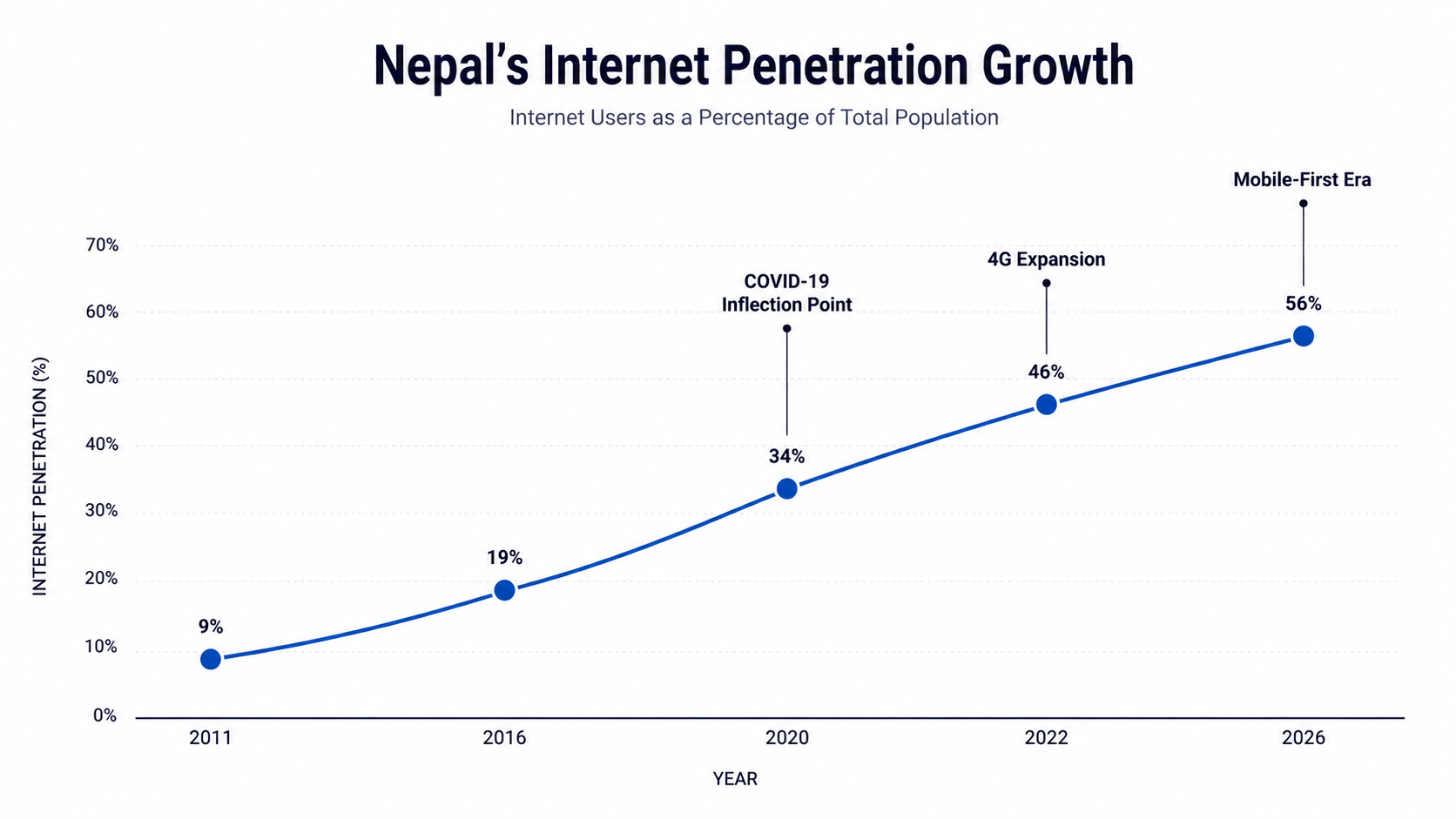
By 2026, the numbers tell a different story. Nepal went from 9% internet penetration in 2011 to 56% today. That is over 16.6 million users online. Total broadband subscriptions hit 30.82 million. Mobile connections now exceed Nepal's total population at 103%. Many Nepalis carry two SIMs to deal with network gaps.
This is not a market dabbling in digital. This is a mobile-first economy. It has arrived.
Nepal's 2026 Digital Ecosystem by the Numbers
Before you spend one rupee on online marketing, learn the field. Here are the numbers that matter for Nepali marketers in 2026.
Internet & Connectivity
- Total internet users: 16.6 million (DataReportal, October 2025)
- Internet penetration: 56% of the total population
- 4G users: 26.58 million — up 1.46 million in one year
- Total broadband subscriptions: 30.82 million
- Mobile broadband (3G + 4G) penetration: 93.84% of the population
- FTTH fiber subscribers: 3.42 million and rising fast
- Mobile SIM cards: 30.9 million for 29.7 million people
Social Media
- Active social media users: 14.8 million (50% of population)
- Facebook: 17.3 million+ users (January 2026) — still Nepal's top platform
- Instagram: ~5 million users, younger and urban
- TikTok: 8+ million users, engagement 3–5x higher than Facebook
- YouTube: Top platform for long-form video, Nepali channels growing fast
- LinkedIn: Rising in Kathmandu's corporate and startup scene
Digital Payments
- eSewa: 10+ million users, present in all 753 local bodies
- IME Khalti (Khalti + IME Pay merged July 2025): Nepal's largest combined wallet
- Fonepay: Leads QR-based merchant transactions
- ConnectIPS: Real-time interbank transfers at scale
- Cash on Delivery: Still 60–70% of e-commerce orders — but falling in cities
E-Commerce
- Daraz: Nepal's largest e-commerce platform by volume
- SastoDeal, Hamrobazaar, HamroDeals: Strong in their niches
- Food and grocery delivery apps building new buying habits
- COD giving way to eSewa and IME Khalti inside the Valley
Urban vs. Rural Digital Divide — and Why It's Shrinking
Three years ago, the common advice was simple: digital marketing in Nepal only works in Kathmandu. That is wrong in 2026.
Nepal Telecom's 4G rollout, private ISPs expanding fiber to secondary cities, and Ncell's rural push have changed the map. Pokhara, Biratnagar, Birgunj, Butwal, and Lalitpur now carry large online audiences. Most agencies still focus on the Valley. That gap is an open door.
Campaigns built around Pokhara's tourism, Biratnagar's trade, or Butwal's retail market are possible now. Most competitors have not caught on yet. That is a real edge.
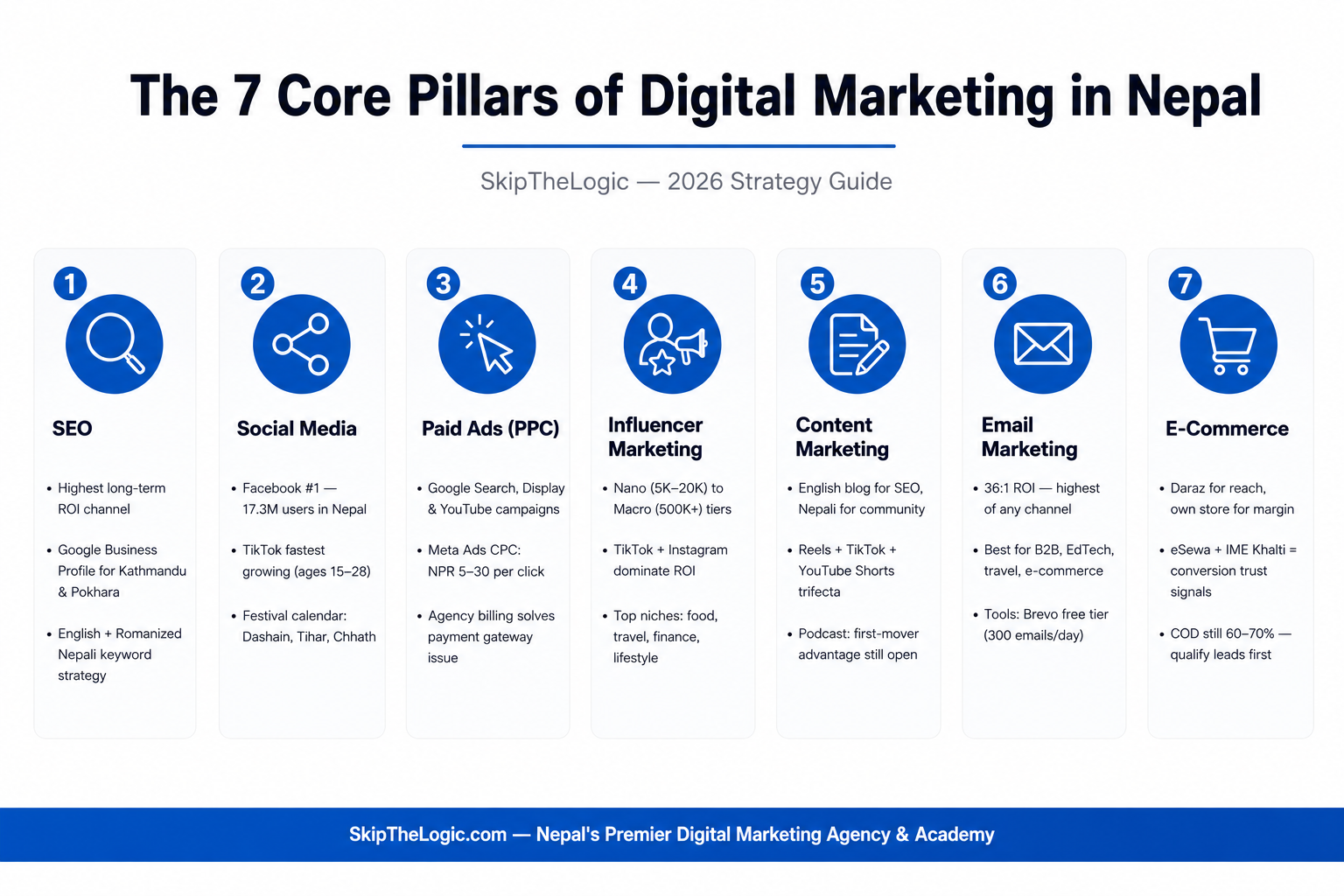
The 7 Core Pillars of Digital Marketing in Nepal
Pillar 1 — Search Engine Optimization (SEO) in Nepal
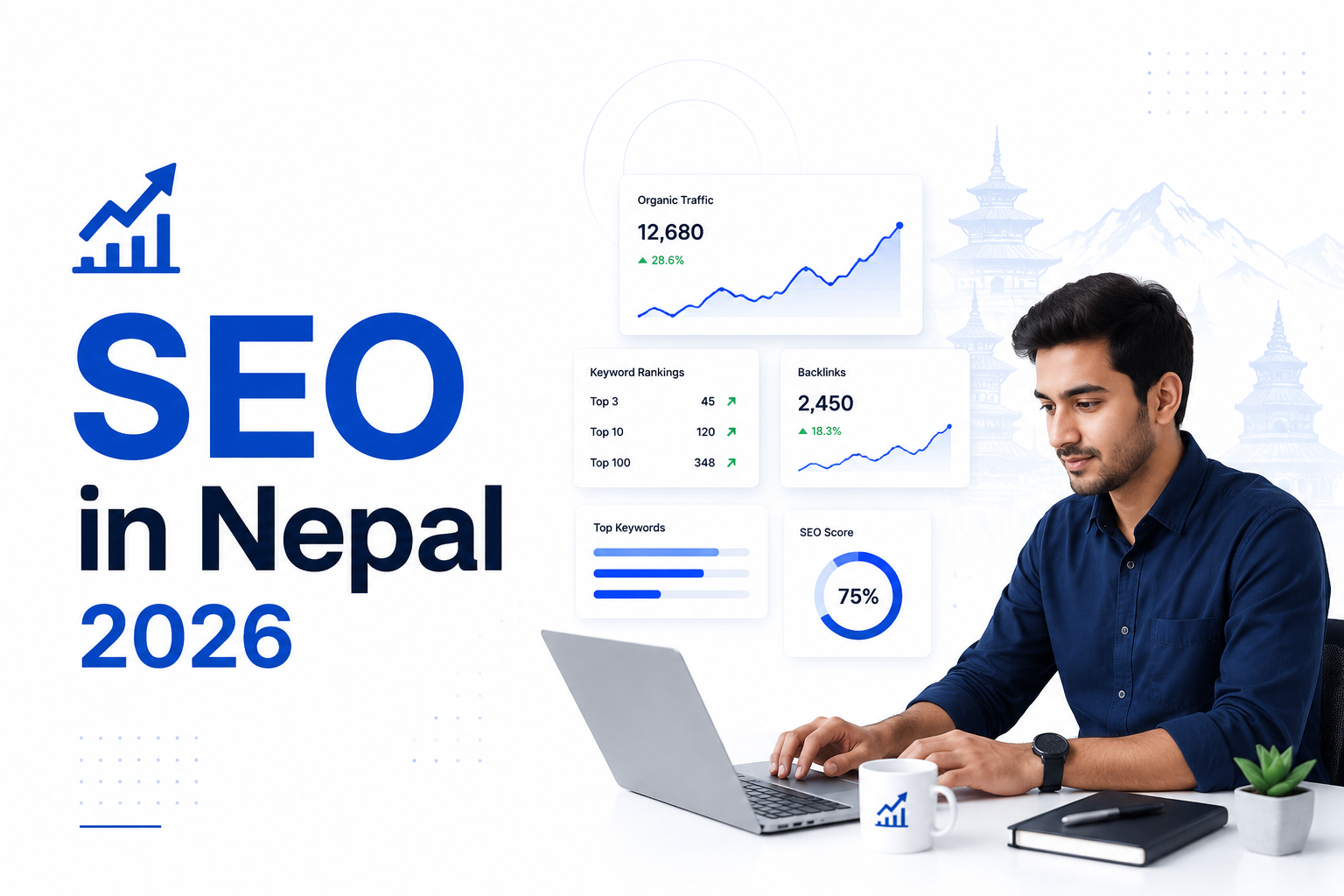
SEO is the highest-ROI channel for Nepali businesses. It is also the most unused. Paid ads stop the moment your budget runs out. SEO does not. A page that ranks on Google page one keeps sending leads. For free. For years.
For SMEs on tight budgets, SEO is not smart. It is essential.
How Nepali Users Search
Know the search habits before you optimize anything. Nepali users search in English. A growing group uses Romanized Nepali — like "sajilai paisa kamaaune tarika." Unicode Nepali search is growing on mobile. But it still covers a small share of buying-intent queries.
Build your SEO strategy in English first. Add Nepali content for local or cultural topics selectively.
Local SEO: The Most Neglected Opportunity
Google Business Profile (GBP) is the most unused SEO tool in Nepal. A full GBP — with posts, accurate hours, photos, and managed reviews — can put your business in the Google Maps 3-pack.
Searches like "digital marketing agency Kathmandu" or "accountant Lalitpur" are ready-to-buy. The user wants to act now. If you are not in the map pack, you are giving that customer to a rival.
The SkipTheLogic SEO Approach
Our SEO audits go beyond keyword reports. We check technical health — Core Web Vitals, crawl errors, schema markup. We review content structure — topic clusters, internal links, search intent. We run gap analysis to find keywords rivals rank for that you have not touched. It is a system. Not a checklist.
What Good SEO Results Look Like in Nepal
A Kathmandu restaurant with a fully optimized GBP and five blog posts can rank on page one in 90 days. A service business in Pokhara targeting "trekking guide Pokhara" can generate calls from organic search within four months. These are real outcomes — not projections.
The key is consistency. One blog post does nothing. Ten posts with proper keyword targeting and internal links build momentum. Thirty posts with schema markup, GBP activity, and local citations build a moat.
Start small. Be consistent. The results compound.
Key SEO Actions for Nepali Businesses:
- Claim and set up your Google Business Profile fully
- Build pages targeting city + service pairs ("SEO services in Kathmandu," "digital marketing Pokhara")
- Write blog posts that answer what your customers search for
- Add FAQ schema and Article schema to win Featured Snippets
- Build local citations on Hamrobazaar, Nepal Yellow Pages, and local business portals
A in-depth analysis of the landscape, scope, and future about SEO in Nepal is placed in this blog - SEO in Nepal 2026
Pillar 2 — Social Media Marketing Nepal
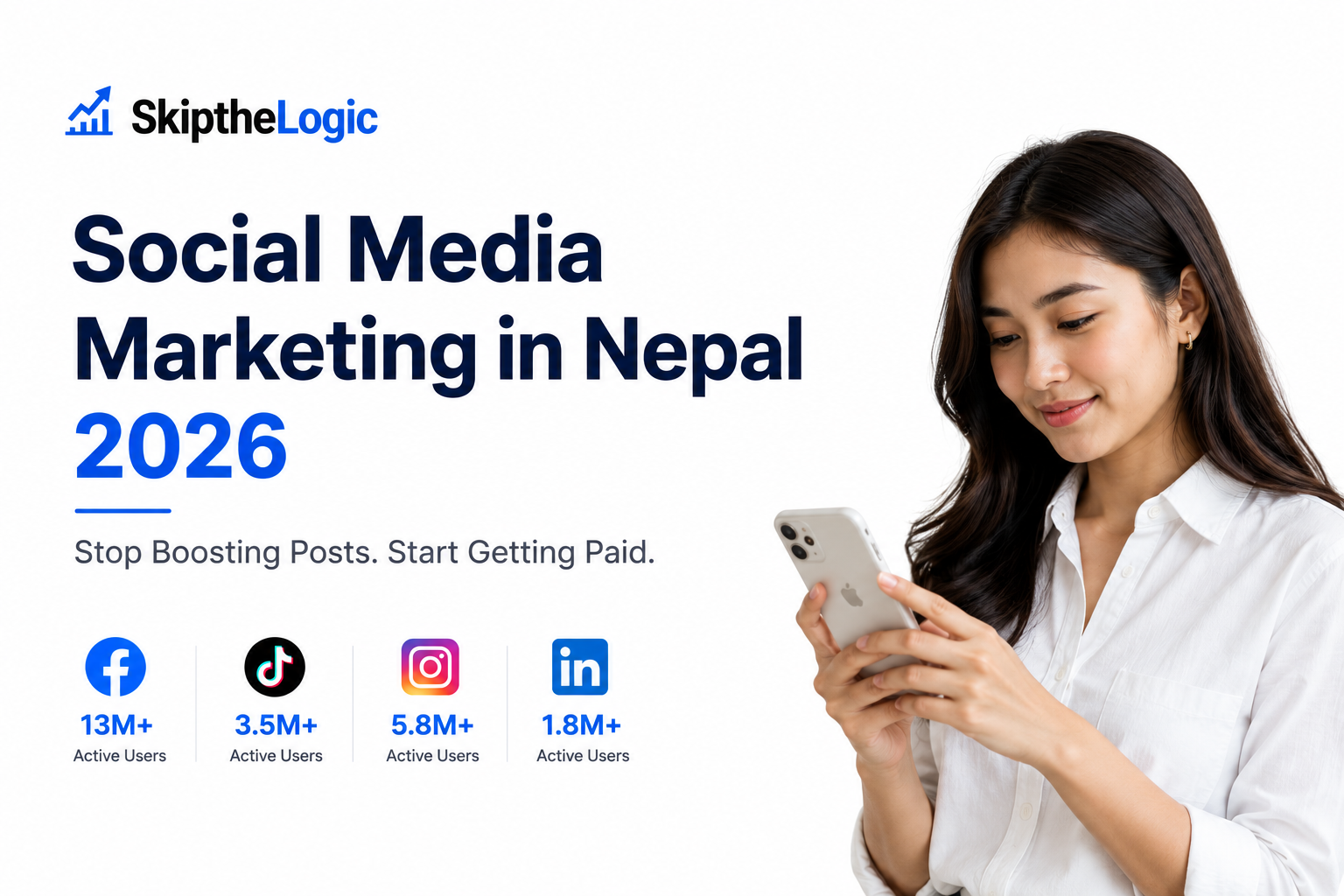
Social media is where attention lives in Nepal. 14.8 million users spend 2.5+ hours a day on social platforms. It is the most direct channel to reach Nepali buyers. But reach without a plan is only noise.
Platform-by-Platform Breakdown
Facebook (17.3 million users): Nepal's heavyweight. Broad reach, community building, and local discovery all happen here. Facebook Groups — buy/sell groups, community forums, niche communities — drive huge organic reach. Most brands ignore them.
Facebook targeting in Nepal is precise. Reach by district, age, interest, device, and behavior. Best posting times: 7–9 AM, 12–1 PM, 8–10 PM in Nepal Standard Time. Native video under 3 minutes beats image posts in organic reach.
TikTok (8+ million users): The 2023–2024 ban barely hurt Nepali habits. TikTok came back stronger. It is the top platform for ages 15–28. That is the most valuable age group for consumer brands, food, fashion, and education. Brands on TikTok get engagement 3–5x higher than Facebook for the same spend. Use native formats: product demos, behind-the-scenes, trending audio.
Instagram (~5 million users): Urban, educated, 18–35. Nepal's aspirational platform. Premium brands, lifestyle, travel, and fashion perform here. Reels beat static posts in organic reach. Stories work for limited-time offers and polls. Do not overlook the diaspora. Nepalis in Qatar, Saudi Arabia, UAE, the US, and Australia buy from Nepal-based brands on Instagram.
YouTube: Top platform for long-form content. Nepali-language channels in food, travel, finance, and tech grow fast. YouTube pre-roll ads reach large audiences at low cost.
LinkedIn: Rising in Kathmandu's B2B space. Use it for IT, NGOs, consulting, education, and anyone targeting HR managers or senior staff.
The Festival Calendar Advantage
Most brands plan Dashain content the week before Dashain. That is why they lose.
Nepal's golden quarter runs September through November. Dashain and Tihar together. Spending surges across every category. Ad costs rise. CPMs go up. Brands that start six weeks early, build content, and warm up their audiences win. Reactive brands fall behind.
Other windows to activate: Chhath Puja (huge in the Terai), Valentine's Day, Eid, Lhosar, and Buddha Jayanti for travel brands. Build your calendar around Nepal's culture — not global templates.
A in-depth analysis of the landscape, scope, status, and future about Social Media Marketing in Nepal is placed in this blog - Social Media Marketing in Nepal (2026): Stop Boosting Posts. Start Getting Paid.
Pillar 3 — PPC & Paid Advertising in Nepal
Paid ads shorten the time to generate leads. Done well, they scale. Done badly — which is common in Nepal — they cost money.
Google Ads in Nepal
Google Search is the most intent-driven ad format available in Nepal. Someone searching "digital marketing course Kathmandu" is telling you what they want. You pay to appear at the top. Well-run Search campaigns beat social ads on conversion rate for high-value purchases.
Google Display and YouTube ads build awareness — brand recall before a purchase decision.
2026 Nepal benchmarks:
- Average CPC (Google Search): NPR 15–80, by industry
- Hospitality, real estate, and finance keywords cost more
- Education and e-commerce CPCs tend to be lower
Meta Ads (Facebook & Instagram)
Meta ads offer deep audience targeting for the Nepali market. 2026 benchmarks:
- Average CPM: NPR 60–200
- Average CPC (link clicks): NPR 5–30
- Average CPL (lead gen forms): NPR 150–800, varies by industry
The Payment Problem — and Real Solutions
Most Nepali businesses cannot run international ad accounts without an international card. Nepal Rastra Bank limits outward foreign exchange. Paying for Google Ads or Meta Ads through a local bank account is hard.
Solutions that work in 2026:
- Agency billing: Work with SkipTheLogic. We handle international payment and invoice you in NPR.
- USD Visa/Mastercard: Get one through NABIL, Standard Chartered, or NMB Bank with NRB forex approval.
- eSewa international payments: Now supports select ad platform payments.
- Prepaid international cards: Available through some fintech providers.
Do not let payment friction stop you. It is solvable. Find the right partner or bank product.
Pillar 4 — Influencer Marketing with Nepali Creators
Influencer marketing in Nepal has matured. It moved from free product swaps to formal paid deals. For the right categories, it delivers strong ROI.
The Nepali Creator Landscape
Nepal's creator economy lives on Instagram and TikTok. YouTube is the secondary platform. The tiers:
- Nano creators (1K–10K followers): High engagement, niche audiences, low cost (NPR 2,000–8,000 per post). Best for local campaigns.
- Micro creators (10K–100K followers): The sweet spot for Nepali SMEs. Engagement runs 3–8x higher than macro creators. Fees range NPR 8,000–50,000 per post.
- Macro creators (100K–500K+ followers): Awareness at scale. Fees run NPR 50,000–300,000+ per post. Right for national launches.
Categories That Perform Best
Food reviews, travel, lifestyle, tech, education, and personal finance lead in Nepal's influencer market. Finance creators are growing fast. They have credibility with younger Nepali audiences who care about savings and career income.
Red Flags to Avoid
Fake followers are a problem in Nepal. Before any deal, check the engagement rate. Formula: (likes + comments) ÷ followers × 100. A creator with 200K followers and 500 likes per post has a 0.25% rate. That is a warning sign. Real micro-creators in Nepal show 4–10%. Ask for past campaign data before you sign.
Pillar 5 — Content Marketing for Nepali Businesses
Content is the engine behind every digital channel. SEO needs it. Social media needs it. Email needs it. Paid ads need it. Content marketing is not one channel. It makes all channels work better.
Blogging: English vs. Nepali
Write in English for search traffic. Commercial queries in Nepal happen in English. Use English for service pages, case studies, and articles. Use Nepali for social sharing, community content, and WhatsApp — especially Facebook.
The smart split: English blog for SEO, Nepali content for community.
Video Is Non-Negotiable
In 2026, video is the baseline. Not optional. The winning format split:
- 15–60 second vertical video for TikTok and Instagram Reels
- 60–90 second video for YouTube Shorts and Facebook
- 8–20 minute long-form for YouTube — education, reviews, authority content
No expensive gear needed. Nepali audiences engage with honest smartphone content when the value is real. Substance beats polish.
Podcasts: The First-Mover Window
Nepal has fewer than 50 consistent podcasts with real audiences. For businesses in finance, law, education, marketing, real estate, or health — a strong podcast now is a first-mover edge. That window closes in 18 months.
How to Repurpose Content Across Channels
Most Nepali businesses create content for one channel and stop. That is wasted leverage.
One long YouTube video becomes five short Reels clips. A Reel becomes a TikTok. A TikTok script becomes a blog post intro. A blog post becomes five LinkedIn posts. Five LinkedIn posts become an email newsletter.
One piece of original content, distributed across five channels, multiplies your reach without multiplying your effort. This is how small Nepali teams compete with bigger brands. Work smarter, not harder.
E-E-A-T in the Nepali Context
Google's E-E-A-T signals — Experience, Expertise, Authority, Trust — apply in Nepal. In practice: name your authors, show credentials, verify your business info (NTA registration, NRB license where relevant), add real testimonials, and publish useful content over time. These signals tell Google who to trust.
Pillar 6 — Email Marketing in Nepal
Email is the most overlooked channel in Nepal. That is why it is an opportunity.
You own the list. No algorithm can take it away. Email is the top channel for high-value purchases. The cost per send is near zero. For B2B, EdTech, travel, and e-commerce, email marketing delivers 36:1 ROI globally. Nepali businesses have barely started.
Building a List in Nepal
Lead magnets that work: financial calculators, business plan templates, free e-books, discount codes, and local guides like "How to Register a Business in Nepal." Give something useful. Get an email address back.
Why Email Works Better Than Social for Sales
Social media reaches a broad audience. Email reaches a confirmed one. Every person on your list chose to be there. That intent changes everything.
A Nepali EdTech brand with 5,000 email subscribers can generate NPR 200,000 in course sales from a single well-written email. No ad spend. No algorithm. No CPM auction. The list is an asset. Build it from day one.
Email also survives platform changes. Facebook can restrict your page reach overnight. TikTok can get banned. Your email list stays with you.
Tool Accessibility
Mailchimp, Brevo, and ConvertKit are the most-used email tools in Nepal. Payment is the friction — Mailchimp's paid plans need an international card. Brevo's free tier (300 emails/day) is the right start for most Nepali SMEs.
Pillar 7 — E-Commerce & Performance Marketing
Nepal's e-commerce market is growing. Post-pandemic retail has shifted online. The habits are forming — and they are sticking.
Daraz vs. Your Own Store
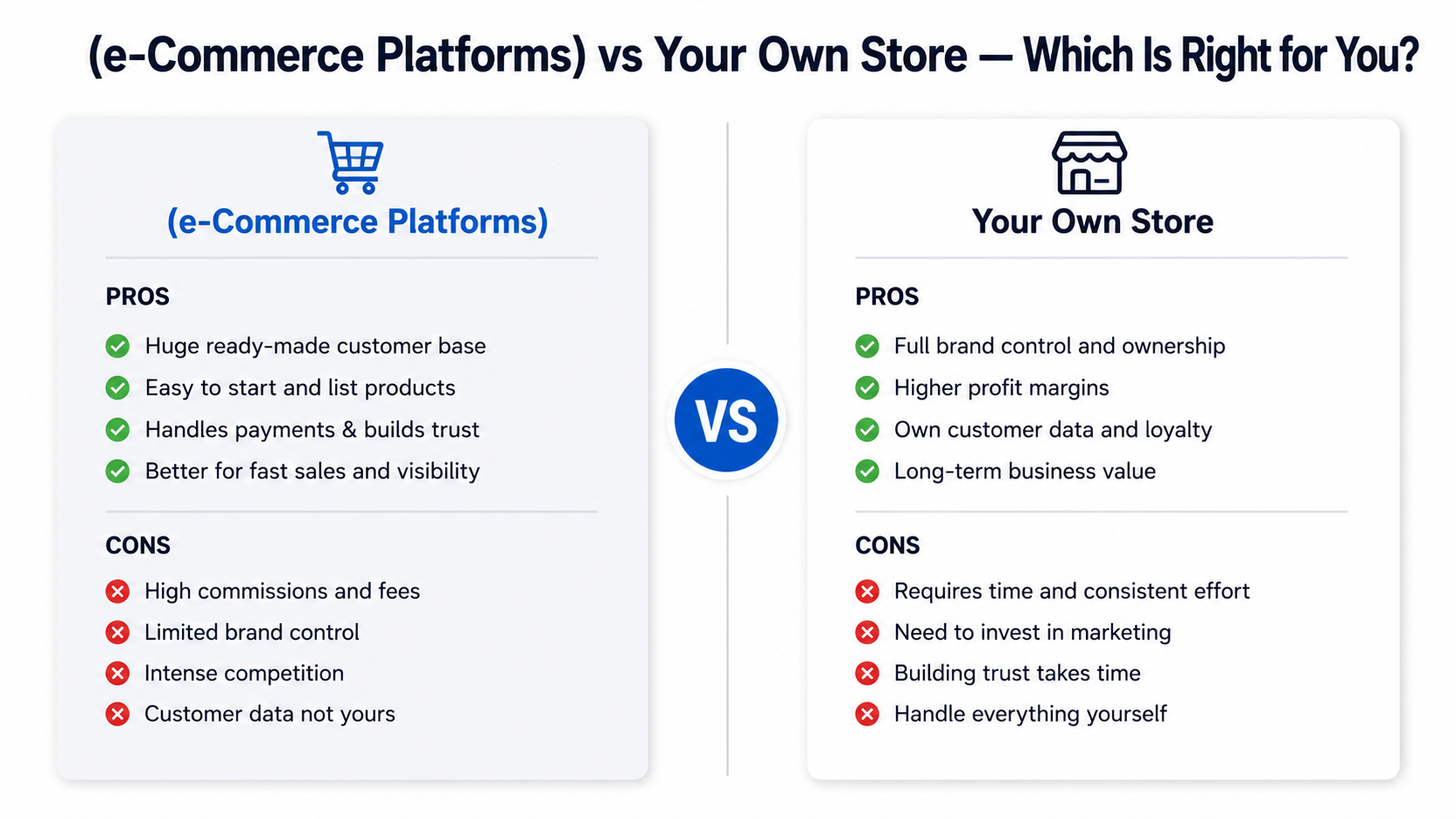
Daraz or any E-Commerce platforms gives you an existing audience, built-in payments, and logistics. The trade-offs: 5–15% commission by category, weak brand control, and no customer data ownership.
Your own WooCommerce or Shopify store takes more setup. But you get full brand control, customer data, better margins, and retargeting capability. Best strategy: use Daraz for discovery, your own site for loyalty and margin.
The COD Reality
Cash on Delivery covers 60–70% of orders nationally. Inside Kathmandu Valley, it is moving toward 50/50 as eSewa and IME Khalti become normal. COD return rates are far higher than prepaid. Build campaigns to qualify buyers — do not chase order volume.
eSewa & IME Khalti as Trust Signals
Add eSewa and IME Khalti payment badges to your checkout page. It is a fast, easy conversion win. Nepali buyers link these wallets to safety. If your store does not have these integrations, fix that first.
The Nepali Consumer in 2026 — Behavior, Trends & Opportunities
How Nepali Consumers Discover Brands Online
The Nepali buyer's path in 2026 is predictable: Search → Social Check → WhatsApp → Purchase.
They find you on Google or TikTok. They check your Facebook page for reviews. They ask friends on WhatsApp. Then they decide. A broken digital presence kills conversions at every step. Great SEO but a dead Facebook page loses deals. Active Instagram but no website loses deals. You need all parts working together.
Why Phone Numbers Still Build Trust
Many marketers are surprised by this. Nepal is digitally advanced. Why do phone numbers still matter?
Nepali buyers want to know a real person is behind the business. A phone number they can call. An address they can visit. Even if they never use either one — knowing they exist builds trust. Put your number in the website header. Put it on your GBP. Put it in your Facebook About section. Add your address even if you work online. These steps lift conversion rates.
The WhatsApp Factor
WhatsApp is Nepal's informal sales channel. Buyers check your social media. Then they message you on WhatsApp before ordering. Many Nepali businesses close more sales on WhatsApp than through any checkout page. Be active there. Reply fast. If you are slow on WhatsApp, you lose deals you never knew were close.
Payment & E-Commerce Behavior
eSewa is now synonymous with digital payment in Nepal. Like Google with search — a category-defining brand. With 10+ million users in all 753 local bodies, it is near-universal.
The 2025 Khalti-IME Pay merger into IME Khalti created Nepal's largest wallet by user count. More competition means better rates, more cashback, and wider merchant reach.
The remittance economy matters for digital marketing too. Nepal receives roughly $9–10 billion in annual remittances. One of the highest remittance-to-GDP ratios in the world. Households getting money from the Gulf, Malaysia, South Korea, or the West have more to spend. They buy online. Smart marketers target this group.
Festival & Seasonal Marketing Opportunities
Nepal's calendar has clear spending peaks. Plan for them months in advance.
Dashain-Tihar (September–November): Nepal's golden quarter. Spending jumps in clothing, electronics, food, gifts, and travel. Ad costs rise. CPMs climb. Brands that prepare six weeks early — with strong creative and warm audiences — beat brands that scramble at the last minute.
Valentine's Day (February 14): Urban youth spending on gifts and dining grows every year.
New Year: January 1 (AD) and Nepali New Year (Baisakh, mid-April) are two separate windows.
Chhath Puja: Big cultural and commercial weight in the Terai. Underused by Kathmandu-focused brands.
Buddha Jayanti, Indra Jatra, Gai Jatra: Strong for travel, hospitality, and cultural brands.
Build your quarterly plan around Nepal's actual calendar. Not templates from global marketing playbooks.
A Strategic Framework for Nepali Business Owners
The SkipTheLogic Digital Growth Ladder - After working with businesses across Nepal, we see the same pattern. We call it the Digital Growth Ladder — four stages, each one builds on the last.
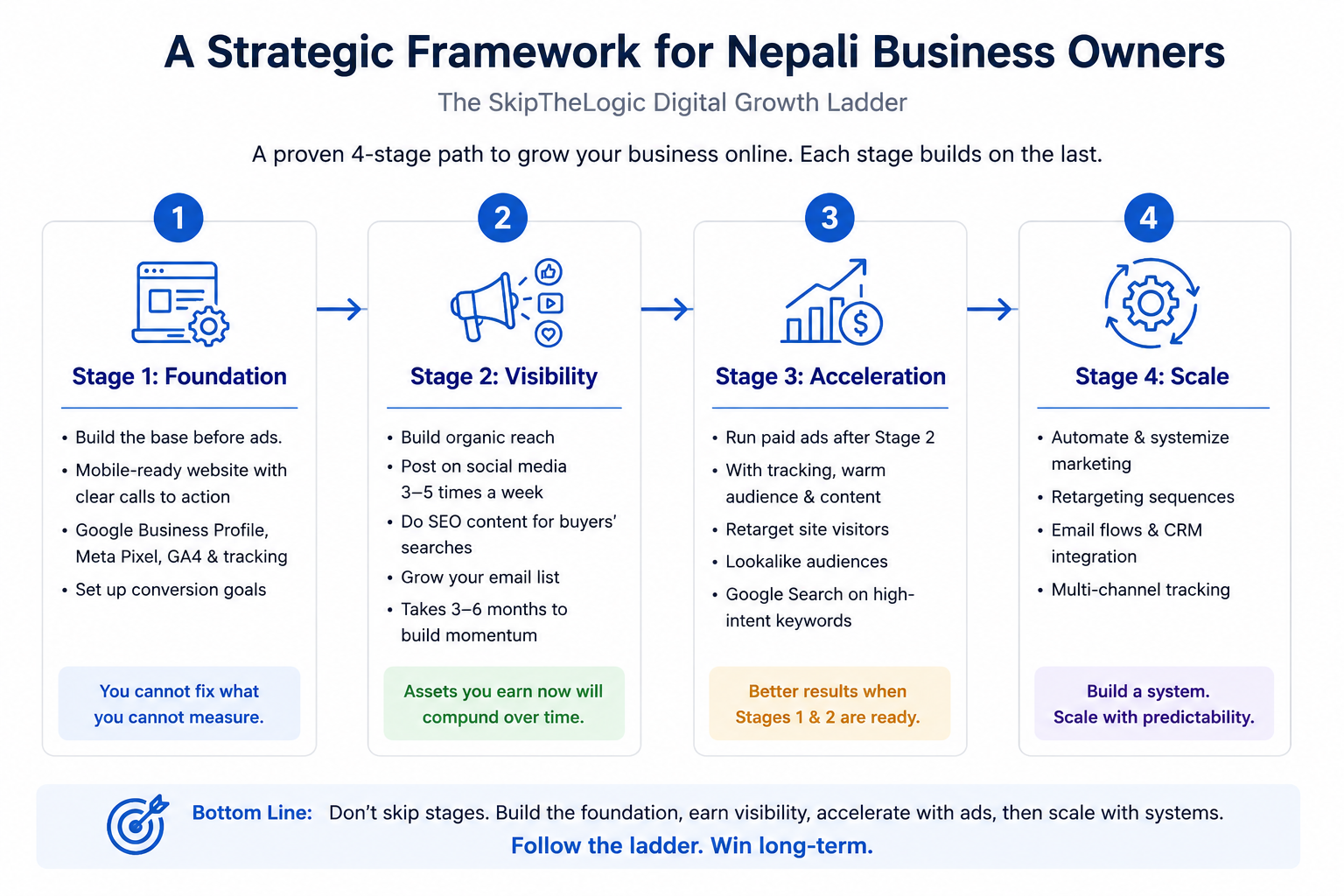
Stage 1: Foundation
Before you spend on ads, get the base right. You need: a mobile-ready website with clear calls to action, a full Google Business Profile, Meta Pixel and GA4 installed and tracking, and conversion goals set up.
Most Nepali businesses skip this stage. Then ads fail and they blame the platform. You cannot fix what you cannot measure.
Stage 2: Visibility
Build organic reach. Post on social media 3–5 times a week. Run SEO content targeting your buyers' searches. Grow your email list. Stage 2 is slow. It takes 3–6 months to build momentum. But the assets you earn — rankings, audiences, email lists — paid channels cannot replace them.
Stage 3: Acceleration
Paid ads come in here — after Stage 2, not before. With a tracked site, a warm audience, and content live, campaigns work. Meta retargeting to site visitors. Lookalike audiences from real customers. Google Search on high-intent keywords. All of these work far better with Stages 1 and 2 in place.
Stage 4: Scale
Automation, retargeting sequences, email flows, CRM integration, and multi-channel tracking. This is where marketing becomes a system. Most Nepali businesses are in Stage 1 or 2. Stage 4 is where the real competitive gap opens up.
Competitive Intelligence: What Most Nepali Businesses Skip
Before building any strategy, study your competitors. Not to copy them. To find the gaps they left open.
Start free. Google your main service keywords. Study the page one results. Visit competitor websites. Open Facebook Ad Library and search their brand name — all their running ads are visible for free. Read their GBP reviews. Bad reviews from customers are content ideas and product signals for you.
Paid tools like SEMrush or Ahrefs go deeper. They show which keywords competitors rank for, where their traffic comes from, and which sites link to them. Even a one-month subscription gives enough data to plan six months of content and SEO.
At SkipTheLogic, competitive gap analysis is the first output of every audit. It shows exactly where to focus first.
Budget Allocation Guide
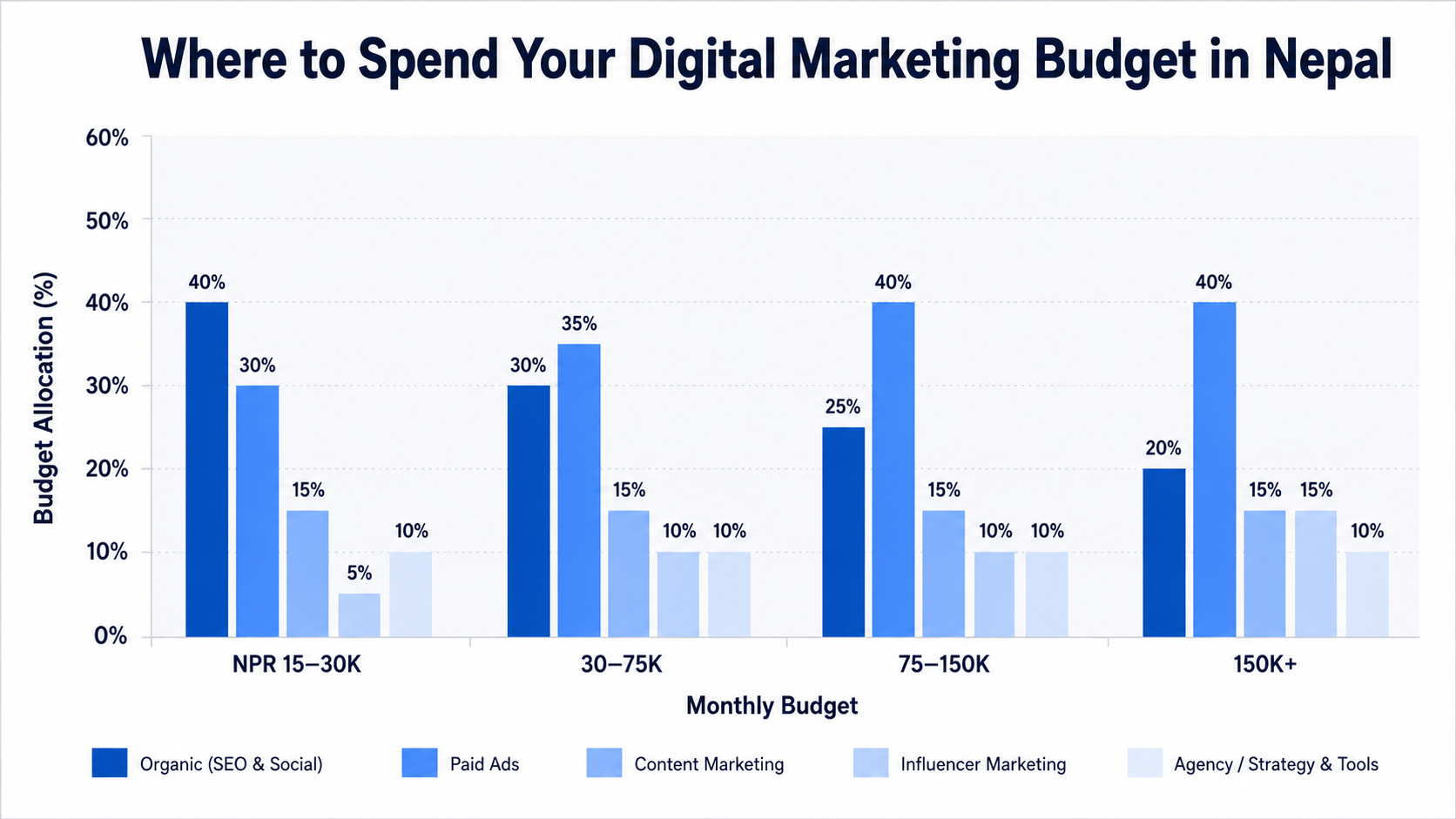
The most common question at SkipTheLogic: how much should I spend? Here is a clear breakdown by budget level.
NPR 15,000–30,000/month: Go organic only. SEO basics, Google Business Profile, consistent social posts. No paid ads yet. Build the foundation.
NPR 30,000–75,000/month: Add selective paid ads. Start with Meta Ads to a warm audience. Put 60% toward ads, 40% toward content and tools.
NPR 75,000–150,000/month: Run a full funnel. Google Search + Meta Ads + micro-influencer campaigns + SEO content. Allocate by channel performance — not gut feeling.
NPR 150,000+/month: Multi-channel and data-driven. Dedicate resources per channel. Get an agency or build an in-house team.
Common Mistakes Nepali Businesses Make
Boosting posts instead of running campaigns. The Boost Post button is built for ease, not results. A structured Meta Ads campaign with targeting, split tests, and conversion tracking will beat a boosted post every time with the same budget.
No conversion tracking. Ads without Facebook Pixel or GA4 are money spent in the dark. You cannot improve what you cannot see.
Skipping SEO while spending on ads. Paid traffic stops when budget stops. SEO keeps running. Both have a role — but skipping SEO means you pay forever for traffic you could earn.
Choosing the cheapest vendor. NPR 5,000/month "full digital marketing" packages exist in Nepal. They deliver nothing measurable. In this field, you get what you pay for — less.
No clear objective. "We want more customers" is not a goal. Set specific targets: leads per month, cost per lead, revenue from digital. Without targets, nothing gets better.
Digital Marketing Career in Nepal — Roadmap, Salaries & Skills
Is Digital Marketing a Viable Career in Nepal in 2026?
Yes. Without question.
Nepal's digital economy has created demand that far outpaces supply. Businesses with no digital budget five years ago now treat it as a fixed cost. E-commerce, fintech, NGOs, media brands, and government programs all need digital talent. The pool of skilled practitioners is still small.
Digital marketing also opens three other income paths:
- International freelancing: Upwork and Fiverr let Nepali marketers earn in USD from home. A mid-level SEO or paid ads specialist can earn $1,000–$3,000/month. That matches or beats senior corporate salaries in Kathmandu.
- Agency ownership: Nepal's agency market is fragmented. A skilled practitioner who packages services and delivers results can build a profitable business fast.
- Content creation: YouTube, TikTok, and Instagram generate real income for consistent Nepali creators.
Why Nepal Needs More Skilled Digital Marketers
The supply gap is real. Kathmandu has hundreds of digital agencies. Few deliver consistent, measurable results. The reason is simple — most practitioners learned through trial and error with no structured foundation.
Good businesses know the difference. They are willing to pay for marketers who can show proof. Not certificates. Proof. Campaign data. Revenue numbers. Leads generated. Rankings won.
If you build those skills, Nepal's market will pay you well for them. And international clients will pay even more.
The gap between a trained digital marketer and an untrained one in Nepal's job market is large. That gap is your opportunity.
Digital Marketing Salary Ranges in Nepal (2026)
Data from various sources and verified figures, has helped us come up with the below mentioned data:
| Role | Entry Level | Mid-Level | Senior Level |
| SEO Specialist | NPR 20,000–30,000 | NPR 45,000–70,000 | NPR 80,000–120,000+ |
| Social Media Manager | NPR 20,000–30,000 | NPR 40,000–60,000 | NPR 75,000–100,000 |
| PPC / Performance Marketer | NPR 30,000–45,000 | NPR 60,000–100,000 | NPR 100,000–150,000+ |
| Content Marketer | NPR 18,000–25,000 | NPR 35,000–55,000 | NPR 60,000–90,000 |
| Digital Marketing Manager | NPR 60,000–80,000 | NPR 80,000–120,000 | NPR 120,000–200,000+ |
| Email Marketing Specialist | NPR 25,000–35,000 | NPR 45,000–65,000 | NPR 70,000–100,000 |
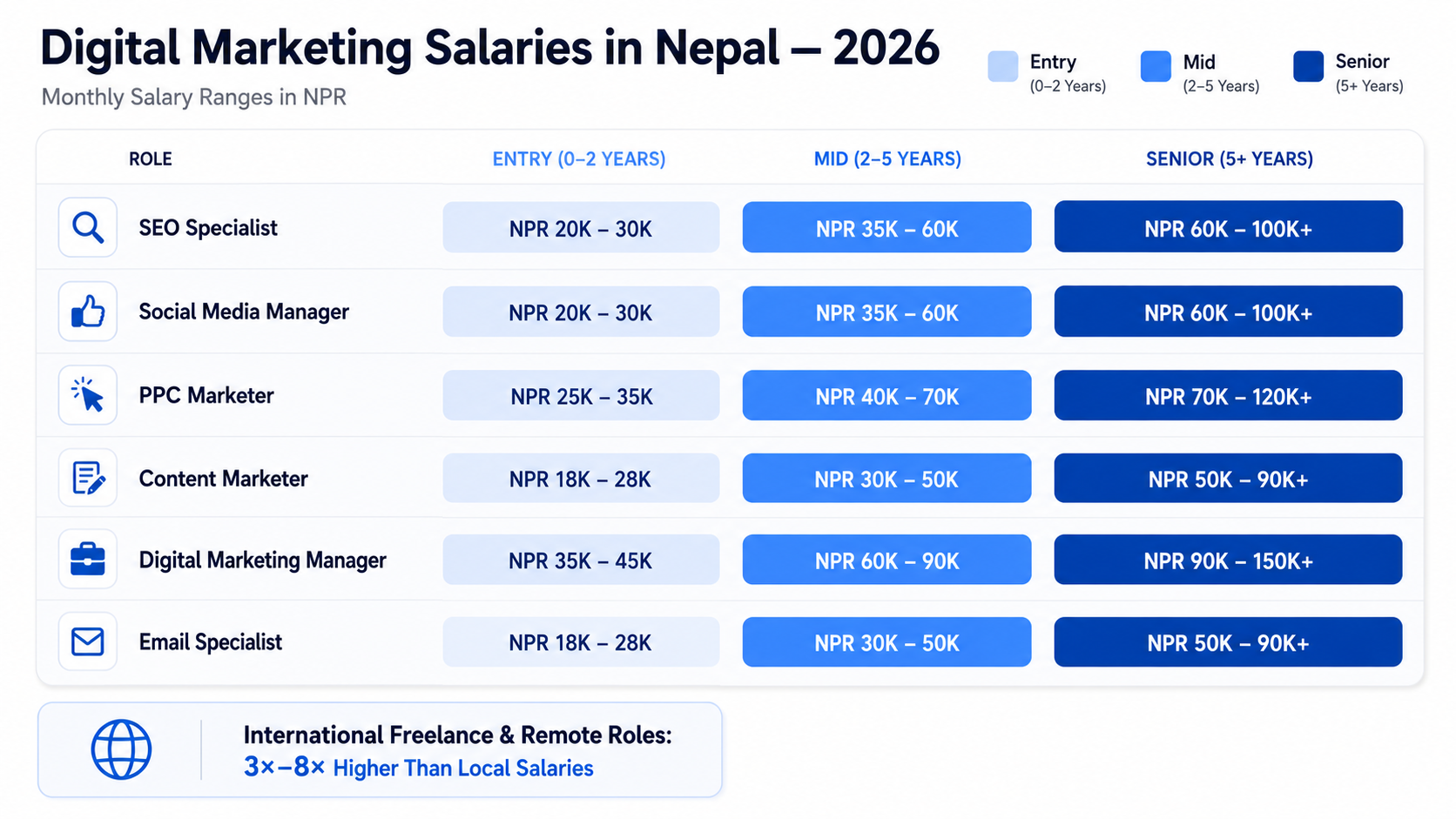
International freelance work pays 3–8x these local figures for the same skill level.
The top-paying roles are Performance Marketer and Digital Marketing Manager. Both require proven, measurable ROI. That is the exact skill most Nepali marketers lack formal training in.
The Skills Every Nepali Digital Marketer Needs in 2026
Technical Skills
- Google Analytics 4 — not optional. GA4 is the standard. Most Nepali marketers do not know it yet.
- Meta Ads Manager — audience setup, campaign structure, creative testing, conversion tracking
- Google Ads — Search campaign structure, match types, Quality Score
- SEO tools — Ahrefs, SEMrush, or free Ubersuggest for keyword and competitor research
- Google Search Console — indexing, query data, CTR improvements
Creative Skills
- Canva and Figma for social graphics and basic design
- CapCut and Adobe Premiere Rush for short video editing
- Copywriting — the most valuable skill in Nepal's market. Words that convert are worth more than any tool certification.
Strategic Skills
- Funnel design — moving people from awareness to purchase
- Campaign planning — allocating budget by channel and goal
- ROI reporting — turning data into business outcomes that leadership trusts
Soft Skills Test, fail, learn, and repeat fast. Tell stories with data. Communicate clearly with clients. Hit deadlines. These skills separate good marketers from technically decent ones.
How to Learn Digital Marketing in Nepal — Your Fastest Path
Free learning exists. Google Digital Garage, Meta Blueprint, HubSpot Academy, and Coursera all offer certifications. They are useful starting points.
But self-learning takes far longer to convert into a paying job. It has no structure, no real campaigns, and no Nepal-specific context. Most self-learners try to apply global frameworks to a market that runs differently. They stall.
The Self-Learning Trap
Here is what happens. A beginner watches SEO videos. They set up a blog. Zero traffic. They switch to Facebook ads. They burn NPR 10,000. No results. They conclude digital marketing does not work. The real problem was never having a clear system.
Knowledge without structure leads to random action. Random action in digital marketing wastes money.
What a Structured Path Looks Like
A good curriculum follows a logical order:
- How search, social, and paid channels work — the core logic
- How to set up tracking before spending anything — GA4, Pixel, conversions
- How to run a real campaign from brief to result — not a simulation
- How to read data and make decisions from it — numbers, not feelings
- How to report results in a way that clients and employers trust
SkipTheLogic Academy is built around this order. Real campaigns from day one. Local case studies from Nepal's actual market. A portfolio built on real results — not screenshots of certifications. You graduate with skills employers and international clients are hiring for right now.
Top Digital Marketing Agencies in Nepal — What to Look For
How to Evaluate a Digital Marketing Agency in Nepal
Nepal's agency market in 2026 is large and uneven. Some practitioners are world-class. Some are generalists. A large number sell impressions and reach with no tie to business outcomes.
Here is what to look for — and what to avoid.
Green flags:
- Reports tied to real business goals — leads, revenue, ROAS — not reach and impressions
- Discovery first — the best agencies learn your business before they pitch a solution
- Verifiable local results — real case studies with real numbers
- Clear contracts with defined deliverables and timelines
- Willingness to say what they will not do — that is a sign of discipline
Red flags:
- Guaranteed #1 Google rankings — no one can promise this
- Packages at NPR 5,000/month for "full digital marketing"
- Cannot explain their process in plain language
- Reports full of vanity metrics, no conversion data
- No discovery process — same pitch to every business
Questions to Ask Before Signing
- "What KPIs do you commit to?"
- "Can I see a past campaign's performance data — not design work alone?"
- "How do you report and in what format?"
- "What happens if we miss targets?"
How to Brief a Digital Marketing Agency in Nepal
A good brief saves money. It saves time. It prevents the most common agency-client disputes.
Before your first meeting, prepare these five things:
- Your goal — Be specific. Not "more customers." Say: "20 qualified leads per month at under NPR 500 per lead."
- Your budget — State it clearly. Agencies that will not work within your budget will tell you. That saves everyone time.
- Your timeline — When do you need results? Three months? Six months? That changes the channel mix.
- Your audience — Who buys from you? Age, location, income level, platform preference. The more you know, the better the targeting.
- Your current data — Share your GA4 access, your Meta Ads history, your GBP insights. Data speeds up the audit.
Agencies that ask for this information upfront are serious. Agencies that skip straight to pitching packages are not.
SkipTheLogic's Approach — Strategy First, ROI Always
SkipTheLogic was built on one belief: most digital marketing fails because no strategy exists. Every engagement starts with a full digital audit. Website. Current channels. Competitor landscape. Business goals. Nothing runs until we understand the picture.
Our work combines technical work with creative output. We track what matters: leads, cost per acquisition, revenue from digital, and organic traffic that converts. Impressions are data. Revenue is the goal.
What Our Process Looks Like
Week one is an audit. We crawl the website for technical issues — broken links, slow pages, missing meta data, schema errors. We review the Google Business Profile. We pull six months of GA4 data. We map what your rivals rank for that you do not.
Week two is the findings report. Plain language. Not a 40-slide deck. Here is what is broken. Here is what it costs you. Here is the fix order.
Then we build the plan. Specific KPIs tied to your business. A timeline. A budget split matched to your stage in the Growth Ladder.
Month one: fix the foundation, install tracking. Month two: launch first campaigns and content. Month three: optimize from real data. That is the cadence.
The Future of Digital Marketing in Nepal — 2026 & Beyond
AI & Automation in Nepali Marketing
AI is no longer a buzzword. It is a daily tool. ChatGPT, Claude, and Gemini are used by Nepali marketers and agency teams for content drafts, campaign ideas, audience research, and competitor checks.
AI does not replace skilled marketers. It replaces low-value, generic work. Template blog posts. Filler social captions. Boilerplate ad copy. What AI cannot do: strategic thinking, local cultural knowledge, relationship trust, and data judgment calls.
Marketers who win in Nepal's AI era cut low-value work with AI tools. They put that time into strategy and creative work that moves the needle.
Three AI tools every Nepali marketer should know in 2026:
- ChatGPT or Claude — For content drafts, ad copy ideas, and campaign research. Use them to start, not to finish. Always edit with local knowledge.
- Canva AI — Design tools with AI features now built in. Faster creative production for social media.
- Google's AI tools in Search Console and Ads — Smart bidding, performance insights, and keyword suggestions all use AI. Turn them on. Learn to read the outputs.
AI is a multiplier. It makes good marketers faster. It does not make bad marketers good.
Marketing automation is also spreading. Make.com, Zapier, and CRM tools are now normal for well-run Kathmandu SMEs and startups. Automated lead nurturing, triggered email flows, and CRM-linked sales follow-up are no longer for big companies.
Voice Search & Vernacular Content
Nepali-language voice search is growing — especially on mobile. Google's Nepali language skills have improved a lot. Mixed Nepali-English "near me" searches are now common. Optimize for question-based queries. Keep your Google Business Profile complete. That is the most direct step local businesses can take right now.
The Creator Economy in Nepal
TikTok monetization is not yet fully open in Nepal. But the infrastructure is forming. Brand-creator deals are becoming formal — moving from product swaps to structured contracts.
For brands, Nepal's creator economy offers authentic reach. Traditional ads cannot match it. For creators, it is a real and growing income stream.
Nepal's YouTube ecosystem has creators with 500K+ subscribers. Their production quality and audience trust rival established media. A deal with the right creator can build brand awareness at a fraction of what ads cost.
Regulatory & Payment Infrastructure
Nepal Rastra Bank keeps pushing for digital financial inclusion. Fonepay's QR network now connects banks and wallets for merchant payments across the country. This cuts cash dependency — which has always slowed digital consumer behavior.
The key regulatory shift to watch is data privacy. Nepal is formalizing its digital economy. Rules on how businesses collect, store, and use consumer data will tighten — likely following India's lead. Build clean data practices now. You will be ahead when those rules arrive.
FAQ: Digital Marketing in Nepal — Built for Google's AI Overview
What is digital marketing and why does it matter for businesses in Nepal?
Digital marketing is the promotion of products and services through digital channels — search engines, social media, email, websites, and apps. It matters for Nepal because the country has 16.6 million internet users and 15+ million active social media accounts. Businesses can reach this audience with precise targeting, measurable results, and budgets that work for small enterprises.
How much does digital marketing cost in Nepal?
Digital marketing in Nepal costs NPR 15,000 to NPR 300,000+ per month. The amount depends on services and scale. Social media management alone runs NPR 15,000–60,000/month. Google Ads and Meta Ads campaigns start at NPR 15,000/month in ad spend. Full-service agency retainers range from NPR 60,000–200,000+ per month.
Which social media platform is best for marketing in Nepal?
Facebook is strongest for broad reach in Nepal — over 17.3 million users as of January 2026. TikTok gives the highest engagement for audiences aged 15–28. Instagram works best for urban and diaspora audiences. The right platform depends on your target age group, location, and product type.
Is SEO effective for small businesses in Nepal?
Yes. SEO drives traffic without ongoing ad spend. Local SEO — Google Business Profile setup and local keyword targeting — delivers strong results for service businesses in Kathmandu, Pokhara, Lalitpur, and other cities. A well-optimized local business can appear in Google's Map Pack within 3–6 months.
What is the average salary of a digital marketer in Nepal?
Digital marketing salaries in Nepal in 2026 range from NPR 20,000 at entry level to NPR 150,000+ for senior performance marketers and managers. Mid-level specialists in SEO, social media, and PPC earn NPR 40,000–70,000 per month. International freelance work pays 3–8x more for the same skill level.
How do Nepali businesses run Google Ads without an international payment card?
Three methods work in 2026. First, partner with an agency like SkipTheLogic that handles international billing and invoices you in NPR. Second, get an international Visa or Mastercard through NABIL, Standard Chartered, or NMB Bank with NRB forex approval. Third, use eSewa's international payment feature — it now supports select ad platform payments.
What is the best digital marketing agency in Nepal?
The best agency for your business works strategy-first, reports on real business outcomes — leads, revenue, ROAS — not vanity metrics, shows verifiable local case studies, and studies your business before pitching. SkipTheLogic is a data-driven agency delivering results across SEO, performance marketing, social media, and AI-powered marketing automation.
How long does it take to see results from digital marketing in Nepal?
It depends on the channel. Paid ads (Meta, Google) can show results within 1–2 weeks. SEO takes 3–6 months to build organic traffic. Social media audience growth takes 3–9 months of consistent content. Email marketing shows results from the first send. The fastest path: combine paid ads for quick results with SEO for long-term growth.
Is influencer marketing effective in Nepal?
Yes — for consumer products, food, lifestyle, education, and entertainment targeting younger audiences. Micro-influencers (10K–100K followers) give the strongest ROI in Nepal. They have real audience relationships and fair pricing. TikTok and Instagram are the top platforms. Always check engagement rates before signing — fake followers are common.
What are the most popular e-commerce platforms in Nepal?
The top platforms are Daraz (largest by volume), SastoDeal (strong in electronics and FMCG), and Hamrobazaar (classifieds marketplace). For food, Foodmandu and Bhoj lead. For brands building their own store, WooCommerce and Shopify are the top choices — both support eSewa and IME Khalti payment integrations.
How do I start a digital marketing career in Nepal with no experience?
Start with free certifications — Google Digital Garage, Meta Blueprint, and HubSpot Academy. Build a personal project: a blog, a social media account, or a page for a small business. Use it to show real work. Then apply to entry-level roles at digital agencies or enroll in a structured program like SkipTheLogic Academy for Nepal-specific, hands-on training.
What digital marketing trends should Nepali businesses watch in 2026?
Five trends matter most. First, AI content tools are standard now — use them or fall behind. Second, short-form video on TikTok and Reels keeps dominating organic reach. Third, micro-influencer deals deliver better ROI than celebrity campaigns. Fourth, digital payment growth is making e-commerce viable across more of Nepal. Fifth, SEO is shifting toward E-E-A-T signals — generic content loses, specialist content wins.
Conclusion: Nepal's Digital Window Is Open — But Not Forever
Every market has a window. A time when the field is still forming. Attention is still affordable. First movers take a lead others cannot close. For digital marketing in Nepal, that window is open right now. And it is starting to close.
Businesses that invested in SEO four years ago in Kathmandu's hospitality and real estate sectors are now impossible to displace. TikTok creators who built audiences early have communities their later competitors cannot buy. Agencies that built real methodology and local case studies in 2022–2024 are winning proposals in 2026.
The same is playing out now — across every sector, in every city beyond Kathmandu. The Pokhara restaurant that builds its digital presence today. The Biratnagar retailer that starts Google Ads before every rival. The Kathmandu startup that grows its email list while attention is still cheap. These become tomorrow's market leaders.
The question is not whether digital marketing works in Nepal. The data is clear. The question is whether you act now — or spend three years watching competitors who did.
The Cost of Waiting
Every month you delay is a month your competitors gain ground.
Consider this. A rival business starts SEO today. In six months, they rank on page one for "digital marketing agency Kathmandu." That ranking sends them five leads a week. At a 20% close rate, that is one new client per week from free, organic traffic. You are paying for leads. They are earning them.
The same math applies to every channel. The Pokhara hotel that starts running TikTok content today builds an audience of 50,000 followers by year-end. When the next tourist season opens, they promote to 50,000 engaged followers at no ad cost. Their competitor starts TikTok then. They start from zero.
Early action in digital marketing compounds. Late action plays catch-up. The market does not wait.